Wide, low or awkward garage openings: what will fit
Most new garage doors are made in standard sizes, for standard openings. That's why the national firms can publish fitted prices for them. If your opening is wider, lower or odder than usual, the choice narrows and a local fitter's survey matters more.
Here's what each kind of awkward opening means.
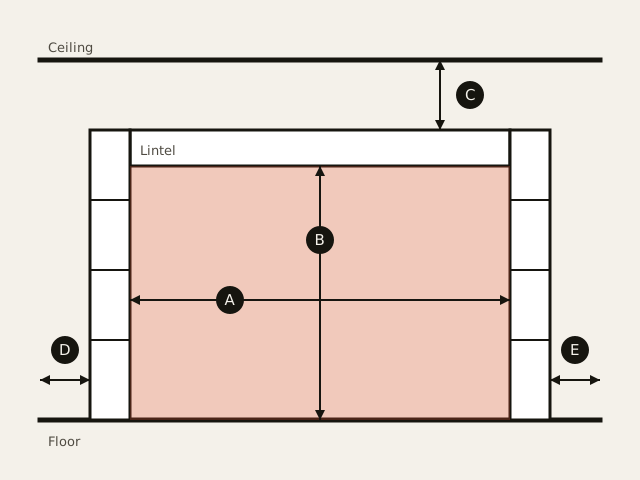
FIG. 1 · What to measure: A the width, B the height to the lintel, C the headroom above the lintel, D and E the room beside the opening.
Not much room above the opening (C)
Roller doors need space above the opening for the box the door coils into, and sectional doors for the curve of their tracks. Each maker publishes how much. If you have very little:
- Side-hinged doors need no headroom at all.
- Low-headroom versions of sectional and roller doors exist, with smaller boxes or different tracks. They cost more, and the fitter needs to measure.
- A roller box can go outside, on the front of the lintel, if there's no room inside. It's visible, so check it suits the house.
No room beside the opening (D, E)
Sectional doors run in tracks fixed beside the opening, and roller doors in guide rails. If a wall or a pillar sits right against the opening, there may be no room for them. An up-and-over door fitted inside the opening, or a door fitted behind the opening (from inside), can get round it.
A wide or double opening (A)
Double-width doors are made in all four kinds. Roller and sectional doors are the most common, because a single up-and-over panel that wide is heavy and swings out a long way. From the firms we checked, an electric double roller door costs £2,395 to £3,495.
A low opening (B)
A low opening is a door made to measure rather than a problem. The thing to check is your car: measure its height, roof box and all, against the opening once the door is open, because some doors hang a little below the lintel when open.
An opening that isn't square
Old garages settle. Measure the width at the top, middle and bottom, and the height on both sides. A small difference is packed out when the frame goes in. A big one may need a sub-frame or some building work first.
When the opening itself needs changing
Widening an opening, or turning two singles into a double, means taking out brickwork that holds up the wall above. It needs a new lintel or beam and building regulations approval. See do you need permission?