Up-and-over, roller, sectional or side-hinged: which garage door suits you
The four kinds of garage door, where each one goes when it opens, the space it needs, and which fits your garage and the way you use it.
The options compared
Up-and-over
Best for A standard opening, a door you open by hand, and the least to spend
One panel tilts up and in. The bottom swings out as it opens, so you can't park right up to it. Canopy types stick out a little when open; retractable ones slide fully inside on tracks.
Roller
Best for Parking close to the door, and keeping the ceiling clear
Slats roll up into a box above the opening. Nothing swings out. It needs room above the opening for the box, and is usually electric.
Sectional
Best for Insulation, quiet running, and a door that doesn't swing out
Horizontal panels run up and back under the ceiling on tracks. It needs headroom and a little room beside the opening, and the ceiling has to be clear of lights and storage.
Side-hinged
Best for Walking in and out often, a workshop, or a wide opening without much headroom
Two doors open like gates, or one wider and one narrower. They need room on the drive to swing open, and some can be automated.
Which fits when
| You park close to the door, or the drive is short | Roller or sectional. Nothing swings out |
|---|---|
| There's very little room above the opening | Side-hinged, or a low-headroom roller or sectional. Ask the fitter to measure |
| You use the garage as a gym, workshop or utility room | Insulated sectional or side-hinged |
| The opening is a usual size and you want the least to spend | Up-and-over |
| You store things up in the roof of the garage | Roller or side-hinged. Up-and-over and sectional doors need the space under the ceiling |
The right door depends mostly on space. Where does the door go when it opens, how much room is there above and beside the opening, and how close do you park? Fig. 1 shows each door's path.
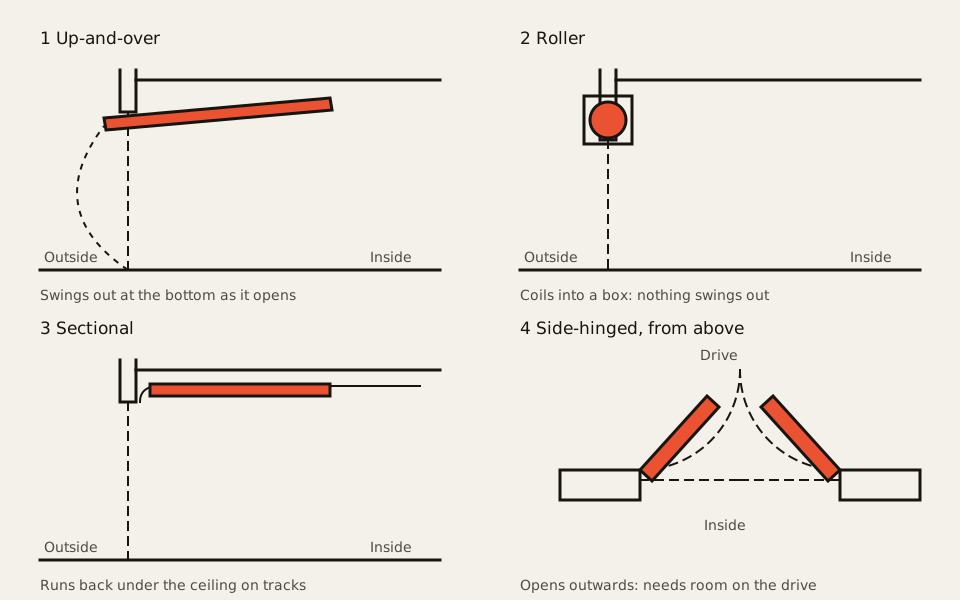
FIG. 1 · Where each door goes when it opens: 1 up-and-over tilts up and in, 2 a roller coils into a box, 3 a sectional runs back under the ceiling, 4 side-hinged doors swing out.
Start with three measurements
Before you choose, measure the width of the opening, the height from the floor to the lintel, and the space from the lintel to the ceiling. How to measure your opening shows each one. Every maker publishes the room its doors need, and your fitter checks it, but knowing roughly what you have narrows the choice.
What each door costs
From the firms we checked, fitted, for a single door: an up-and-over is £795 to £1,300, an electric roller £995 to £3,200, an insulated sectional £1,895 to £2,000 (£1,800 to £2,600 with a motor), and side-hinged doors £1,500 to £4,800. Side-hinged doors vary the most, from plain steel to hardwood made to measure. More in what a new garage door costs.
Manual or electric?
Any of the four can be electric, though roller doors almost always are. A motor needs a socket near the ceiling, and if the garage has no other way in, a way to open it from outside in a power cut. Adding a motor later to a door you already have is often possible: see adding a motor.
Insulated or not?
Sectional and roller doors are often insulated as standard; up-and-over doors usually aren't. It matters if the garage is part of the house or used as a room. See insulated garage doors.