Garage door won't open or close: what to check first
Most garage doors that stop working have one of a handful of faults. Some you can check and put right yourself in a few minutes. Others involve the parts that hold the door's weight, and those are a fitter's job.
Work through these in order. They start with the easy ones.
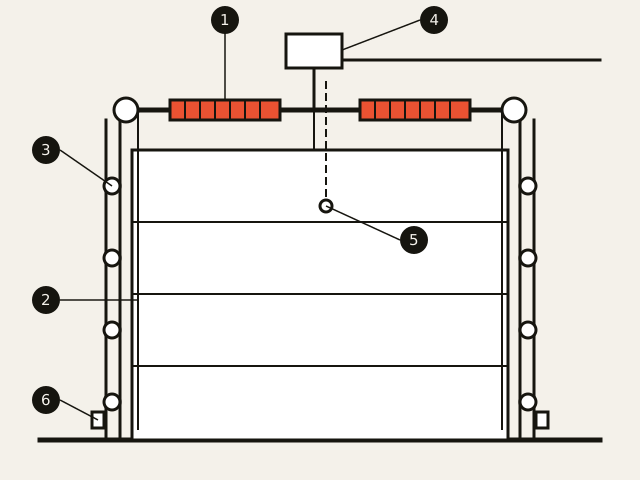
FIG. 1 · The parts of a garage door, from inside: 1 springs, 2 cables, 3 rollers in the side tracks, 4 the motor, 5 the manual release, 6 the safety sensors. Up-and-over doors have springs at the sides instead, but the same idea.
1. Is the motor getting power?
Look for a light on the motor unit. If there's none, check it's plugged in and switched on, and look at your fuse box for a trip. A power cut can also leave some motors needing a reset: the manual will say how.
2. Is it the remote?
Try the wall button, if there is one, or a second remote. If those work, it's the remote's battery. If nothing works, it's not the remote.
3. Are the safety sensors clear?
Most electric doors have two small sensors facing each other near the floor (6). If something breaks the beam between them, the door won't close, or goes back up.
4. Has the manual release been pulled?
Every motor has a cord or handle (5) that disconnects it from the door, so you can open the door by hand in a power cut. If it's been pulled, the motor runs but the door doesn't move. Reconnecting is usually a case of running the motor until it clicks back in. The manual will say.
Only use the release with the door shut, or with someone holding it. If a spring has gone, a released door can drop.
5. Is anything in the tracks?
Look along both side tracks (3) for stones, leaves or ice. Clear them with the door shut. A track that's bent or a roller that's come out of it is a fitter's job.
When to stop and call a fitter
Stop using the door, by hand and with the motor, if you see any of these:
- A gap in a spring's coil (1), or a loud bang from the garage followed by a door that won't lift. That's a broken spring.
- A cable that's frayed, slack or hanging loose (2).
- The door hanging lower on one side, or off its tracks.
- The motor humming or straining while the door doesn't move.
Leave the door shut if you can, keep children and cars clear, and don't try to adjust springs or cables. They hold the door's whole weight. Most of these are repairs, not a new door: see repair or replace? and what repairs cost.